eVTOL transition: flight dynamics & energy use
A simulation example of tiltrotor conversion and acceleration. The plots show flight parameters, control inputs and energy use over the same interval.
From the engineering task to the result
Define the maneuver
Model conversion and acceleration into forward flight, with attention to altitude response and energy use.
Build the dynamics model
Relate propeller speeds and tilt angles, control surface deflections and aircraft motion in a MATLAB / Simulink flight dynamics model.
Balance each flight condition
Select combinations of thrust, propeller tilt and control inputs to balance forces and moments, taking the power requirement into account.
Check the transition
Evaluate the resulting maneuver in simulation: speed, altitude, attitude, angular rate, loads and energy expenditure.
Simulation results
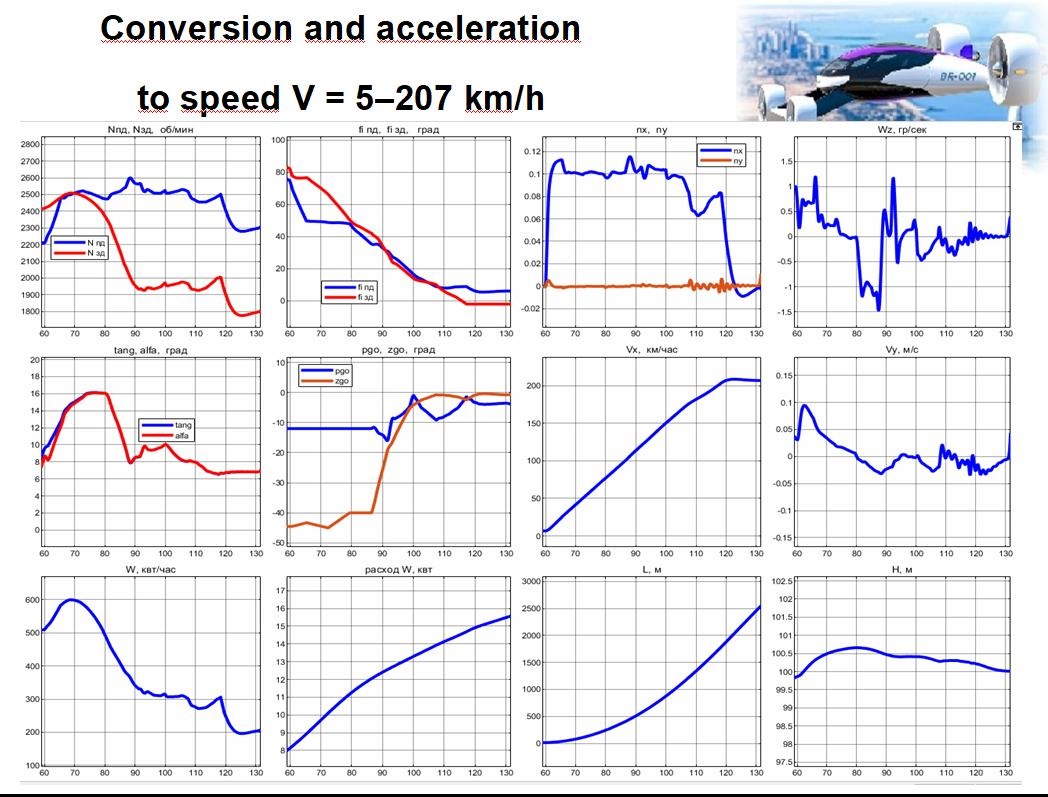
Forward speed
Acceleration through the transition into forward flight.
Power (W)
How the power requirement changes during conversion and acceleration.
Altitude (H)
Altitude response during the transition maneuver.
Other flight and control parameters — 9 plots
Propeller speeds
Front and rear propeller rotational speeds.
Propeller tilt angles
Changes in front and rear propeller tilt during conversion.
Load factors nx and ny
Longitudinal and vertical load factor responses.
Angular rate Wz
Rotational response during the maneuver.
Pitch and angle of attack
Pitch attitude and angle of attack during acceleration.
Control surface deflections
The control inputs shown as pgo and zgo in the original plot.
Vertical speed
Vertical motion during the transition.
Energy expenditure (W)
The accumulated expenditure shown over the simulation interval.
Distance (L)
Distance covered as forward speed increases.